Every child grows and develops in their own time. If you are worried about your child's development then speak to your Health Visitor, Family Nurse or GP.
Appointments for You and Your Baby / Immunisations
Visit from Your Health Visitor
Your Health Visitor might visit you when your baby is 12 weeks old. You can find out more on Happy Healthy Tots.
12 Week Immunisations
Now is the time for your baby's next dose of immunisations. It is vital that your child receives protection against significant illnesses.
Remember to take your red book with you to the appointment.
Your child will receive their next dose of the following vaccines:
The Six-in-one vaccine helps protect your baby against diphtheria, tetanus, pertussis (whooping cough), polio, Haemophilus influenzae type b (Hib) and hepatitis B (HepB).
Rotavirus helps protect your baby against rotavirus.
MenB helps protect your baby against meningococcal group B infection.
The immunisation pages of NHS Inform includes information on when and why you should immunise your child, and what to expect after immunisation.
Public Health Scotland have produced a Protect your child against serious diseases guide. This booklet is provided by your Health Visitor within the first two weeks of your baby being born and will help you over the next five years of your child’s own immunisation journey. This is also available in other languages.
Breastfeeding and Formula Feeding
If you need help with breastfeeding or feeding your baby ask your Midwife, Health Visitor or Family Nurse.
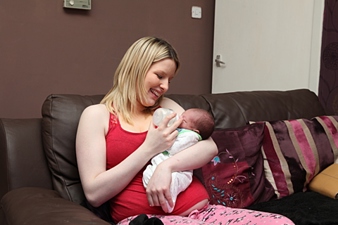
Breast milk or first stage infant formula is all your baby needs until they are around 6 months old.
Babies need to be close to their parents. This helps them to feel secure and loved. This also helps you to learn your baby’s signals for when they are hungry. Let your baby guide you on how much and how often they need fed.
You can find lots of information and resources using the links below:
National Breastfeeding helpline offers both telephone and web chat services. Tel 0300 100 0212 open 9.30am – 9.30pm every day. British Sign Language users in Scotland can contact the helpline via Contact Scotland BSL
If you live in NHS Greater Glasgow and Clyde you can also access Breast Feeding Support using the links below:
Breastfeeding Network (BfN) : this BfN Greater Glasgow and Clyde Families group offers support and chat with families in the local area. Join a virtual peer group every Tuesday and Friday at 2.00pm.
Coping with Crying
We know that babies cry a lot, and it can be really tough sometimes. Every baby is different. Some might be starting to cry less and others might reach the peak of crying a little later before the crying starts to be more purposeful.
ICON gives simple, helpful advice to help you cope with crying and stay calm.
Infant crying is normal
Comforting methods can help
It's Okay to walk away
Never ever shake a baby
It’s based on research and aims to keep babies safe by helping parents and carers understand how to manage stress and avoid actions like shaking, which can be very harmful.
You can find out more information by visiting the ICON website.
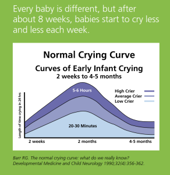
Infant crying is normal The ‘Normal Crying Curve’ shows how babies start to cry more often at about two weeks of age. The crying may get more frequent and last longer during the next few weeks. It will reach a peak at about six to eight weeks, sometimes a little later. Every baby is different, but after about two to three months, babies start to cry less and less each week.
Babies cry for lots of reasons. They are built to cry whenever they need a parent/caregiver to help them. Crying is meant to be upsetting for a parent/caregiver. Crying is nature’s way of making sure adults pay attention quickly.
Try simple calming techniques such as skin-to-skin cuddles, singing to the baby or going for a walk.
It’s Okay to walk away if you have checked the baby is safe and the crying is getting to you.
A baby’s cry is designed to get your attention. It might feel likeit’s driving you crazy, but you can cope. If you think your baby is poorly see a health professional. You can find more information about where to ask for help if you are concerned your baby is unwell on the Royal Hospital for Children, Glasgow. If you’ve done all the normal checks, the baby is not ill, and if you feel yourself reaching that point of stress, take a break! It’s OK to walk away if the baby is safe and the crying is getting to you. Remember this will pass – the crying will stop.
If you are worried that your baby is unwell contact your GP or call NHS 111.
If you are finding it difficult to cope with your baby’s crying talk to someone. Your midwife, health visitor or family nurse can support you.
Practice pausing at the door. It is a great tool to help you make sure you are ready to enter the baby’s room/space and offer care.
Before entering check the 3 C’s.
Can I be careful?
Am I calm?
Will I be caring?
A quick check each time you enter the baby’s room/space will help you know if you need to take a few minutes before seeing to your baby’s crying or ask someone else to help.
Your baby can bring their hands together and is starting to play with their fingers. Your baby is also starting to reach for things and show an interest in their surroundings. Your baby can now get their hands to their mouth! You can help your baby learn how to use their hands by:
Giving them lots of different textures to explore. You will have some different texture toys from your baby box but you can use household objects too. Look for different textures, soft, hard, smooth, rough and things that are different sizes too. A baby sock or a sterilised weaning spoon work at this stage.
Placing objects in their open hand, this will make them close their hand like they do if you give them your finger. Eventually they will be able to reach for and grasp the object themselves.
Using a baby gym or a hanging activity toy for prams, buggies or bouncy chairs so there are toys hanging above your baby. To start with your baby will accidently hit these when they are moving their arms. With time and practice they will be able to grasp them. Something that makes a noise will motivate them to repeat the action.
Your baby's head control is improving, they are more likely to hold it in the middle for longer. Tummy time is vital at this stage. They are now able to lift their head by propping on their forearms. The Association of Paediatric Chartered Physiotherapists (APCP) have a leaflet on the importance of Tummy Time Ideas.
NHS Health Scotland has published three books to encourage parents to support their child's learning through play. These books also encourage you to get your child into good exercise habits.
The first book is called Play@home Baby and is meant for babies from birth to one year. The book has play activities for babies which will help your child's development and well-being.
The books are provided free of charge to all parents with children under 5 years within Scotland. If you have not received the book, then contact your Health Visitor.
Skills for Independence / Activities of Daily Living
Your baby is more aware of and starting to enjoy their daily routines like bath time and feeding. Keep talking, singing and giving your baby clues as to what is happening. Naming body parts during bath time, dressing and nappy changing is a good way to chat to your baby. Find out more from CBeebies Parenting Naming body parts.
Find out more about hygiene for infants:
Hygiene for Infants NHS information from Cambridgeshire and Peterborough Children and Young People's Health Services
Social and Communication Skills
Listening and Understanding
Your baby will take turns in 'chats' by smiling, squealing, cooing and gurgling.
Talking
Your baby is beginning to make a wider range of noises.
Interacting
Your baby is starting to get used to interacting with more people. They will turn their head to people who are talking or singing.
Your baby starts looking towards you when you speak to them.
Your baby might be sleeping for longer spells, they still don't know the difference between night and day. They should still be waking regularly to be fed at night. Some babies cry more than others. Find out more about your baby's sleep from BASIS. If you are worried about your baby's sleep or their crying you can speak to your Health Visitor or Family Nurse or call the Cry-sis helpline for support with crying and sleepless babies.
Your baby has become fascinated by faces and can now recognise faces in photographs.
Any play involving stimulating the different senses will help your child to become more aware of the world around them. CBeebies Parenting have some Sensory Play Ideas you can try.
Editorial Information
Last reviewed:
16/05/2025
Next review date:
31/05/2026
Author(s):
Specialist Children's Services.
Approved By:
KIDS Content Group, SCS Clinical Governance Executive Group
We are one of the leading paediatric care centres in the UK, and the largest in Scotland. We provide family centred care to newborns, infants, children and young people both in hospital and in the community.



 KIDS for Families

 Every child grows and develops in their own time. If you are worried about your child's development then speak to your Health Visitor, Family Nurse or GP.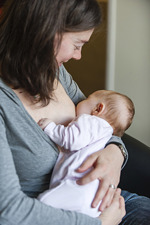





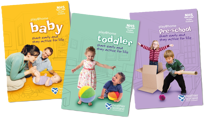 NHS Health Scotland has published three books to encourage parents to support their child's learning through play. These books also encourage you to get your child into good exercise habits.
 Your baby starts looking towards you when you speak to them.