Every child grows and develops in their own time. If you are worried about your child's development then speak to your Health Visitor, Family Nurse or GP.
Your Midwife will usually visit you once you are home during the first 10 days after your baby is born. After that your Health Visitor will usually take over and visit you at home between 11-14 days to meet you and your baby. You might also be offered 2 visits when your baby is between 3 and 5 weeks old. You can find out what to expect during these visits on Happy Healthy Tots.
Routine hearing tests are offered to newborn babies and children to identify any problems early on in their development. You can find out more about hearing tests for children on NHS Inform.
Being a new mum is exhausting. It is important to take care of yourself so make sure you book an appointment with your GP for your 6 week postnatal check-up.
Breastfeeding and Formula Feeding
If you need help with breastfeeding or feeding your baby ask your Midwife, Health Visitor or Family Nurse.
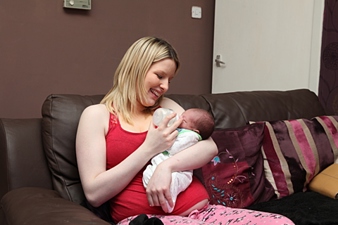
Breast milk or first stage infant formula is all your baby needs until they are around 6 months old.
Babies need to be close to their parents. This helps them to feel secure and loved. This also helps you to learn your baby’s signals for when they are hungry. Let your baby guide you on how much and how often they need fed.
You can find lots of information and resources using the links below:
National Breastfeeding helpline offers both telephone and web chat services. Tel 0300 100 0212 open 9.30am – 9.30pm every day. British Sign Language users in Scotland can contact the helpline via Contact Scotland BSL
If you live in NHS Greater Glasgow and Clyde you can also access Breast Feeding Support using the links below:
Breastfeeding Network (BfN) : this BfN Greater Glasgow and Clyde Families group offers support and chat with families in the local area. Join a virtual peer group every Tuesday and Friday at 2.00pm.
Coping with Crying
We know that babies cry a lot, and it can be really tough sometimes. ICON gives simple, helpful advice to help you cope with crying and stay calm.
Infant crying is normal
Comforting methods can help
It's Okay to walk away
Never ever shake a baby
It’s based on research and aims to keep babies safe by helping parents and carers understand how to manage stress and avoid actions like shaking, which can be very harmful.
You can find out more information by visiting the ICON website.
Try simple calming techniques such as skin-to-skin cuddles, singing to the baby or going for a walk. You can find some other ideas about how to soothe your baby in both the Social and Communication Skills and the Thinking and Feeling sections below.
It’s Okay to walk away if you have checked the baby is safe and the crying is getting to you.
After a few minutes when you are feeling calm, go back and check on the baby.
If you are worried that your baby is unwell contact your GP or call NHS 111.
If you are finding it difficult to cope with your baby’s crying talk to someone. Your midwife, health visitor or family nurse can support you.
Practice pausing at the door. It is a great tool to help you make sure you are ready to enter the baby’s room/space and offer care.
Before entering check the 3 C’s.
Can I be careful?
Am I calm?
Will I be caring?
A quick check each time you enter the baby’s room/space will help you know if you need to take a few minutes before seeing to your baby’s crying or ask someone else to help.
Having been curled up for so long your baby is now finding out how to move their arms and legs in this big wide world.
You will need to help position them and support their movements. To help build their muscles and promote a more rounded head shape, place them in lots of different positions throughout the day when they are awake. Always supervise your baby while they are awake and in different positions, such as lying on their tummy on your chest, supported lying on their side or lying on their back.
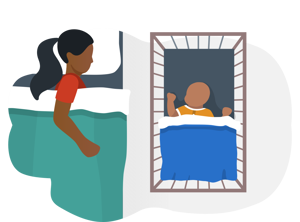
Babies should always be put on their backs to sleep, in a clear, flat sleep space. Find out more information about safe sleep from Scottish Government Safer Sleep for Babies - this leaflet is available in other formats and languages.
You and your baby are getting to know each other, and bonding is really important. Physical contact through massage and touch is a good way to build this. Spending time with your baby's skin against your own is particularly important. For more information look at CBeebies Parenting Touching and Talking to Baby.
Carrying your baby in different positions gives them movement experiences and helps strengthen their muscles. Watch the Tummy Time Alternatives video for ideas about how to hold your baby.
Find out more about the importance of tummy time from Association of Paediatric Chartered Physiotherapist (APCP).
Skills for Independence / Activities of Daily Living
Babies are born being dependent on you for all their care needs. Your baby might not enjoy care routines like nappy changing or bathing. Talk to your baby during care routines and tell them what is happening. For more information look at CBeebies Parenting Chatting while changing a nappy. Give your baby clues as to what is going to happen too by doing the different care routines in different places or using a different texture on the changing mat. You could use a towel for bath time, a fleecy blanket for getting ready for bed and just the mat for nappy changing.
Hygiene for Infants NHS information from Cambridgeshire and Peterborough Children and Young People's Health Services
Social and Communication Skills
Listening and Understanding
It might appear that your baby can only eat, sleep and poo but they are already developing social and communication skills. Your baby was born recognising familiar voices and any music they heard regularly in the womb. They will respond to your mood and will react to your tone of voice or emotion.
Talking
Crying is the most obvious way that your baby communicates. It can be tricky to work out when they are crying in pain, hunger or because their nappy needs changed. Your baby will make gurgling sounds when they are content.
Find out more about why your baby might be crying and what to do to help:
Your baby will enjoy looking at your face and being talked to in a slow gentle voice.
Talking, reading and singing to your baby will help them to develop their early communication and listening skills. Being face to face with your baby is important too.
Your baby can only see faces and objects that are very close at birth. Everything else will appear out of focus. By 4 weeks old they will be able to see a bit further.
From birth your baby responds to touch. They feel safest when you hold them close to you. Spending time with your baby's skin next to yours is important. They can smell you and feel your heart beating which can help them to feel safe too. Find out more on CBeebies Parenting Cuddle time.
Babies often like gentle rocking movement as this is like what they felt in the womb. Be led by your baby. You could try:
Pushing them back and forth in the pram
Rocking them gently in your arms
Carrying them in different positions while you move
Your baby will recognise sounds they heard regularly while in the womb. Using these sounds can help with soothing your baby too. Talk, read or sing to your baby or listen to quiet music together. Some babies find background noise soothing. There are lots of apps you can use to provide background noise. Make sure to have some quiet time too.
Your baby doesn't know about night and day so don't be surprised if they sleep all day and feed all night.
Editorial Information
Last reviewed:
16/05/2025
Next review date:
31/05/2026
Author(s):
Specialist Children's Services.
Approved By:
KIDS Content Group, SCS Clinical Governance Executive Group
We are one of the leading paediatric care centres in the UK, and the largest in Scotland. We provide family centred care to newborns, infants, children and young people both in hospital and in the community.



 KIDS for Families

 Every child grows and develops in their own time. If you are worried about your child's development then speak to your Health Visitor, Family Nurse or GP.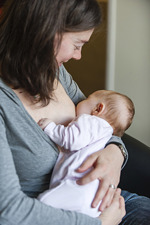





 Babies should always be put on their backs to sleep, in a clear, flat sleep space. Find out more information about safe sleep from Scottish Government
  Babies are born being dependent on you for all their care needs. Your baby might not enjoy care routines like nappy changing or bathing. Talk to your baby during care routines and tell them what is happening. For more information look at CBeebies Parenting
  Crying is the most obvious way that your baby communicates. It can be tricky to work out when they are crying in pain, hunger or because their nappy needs changed. Your baby will make gurgling sounds when they are content.
 Your baby will enjoy looking at your face and being talked to in a slow gentle voice.
 Babies often like gentle rocking movement as this is like what they felt in the womb. Be led by your baby. You could try: