

Fetal Alcohol Spectrum Disorder (FASD)
 KIDS for Families

 On this page:
We know that there are natural differences between human brains. This is known as neurodiversity. Some human brains have more in common and we can group them together. Most brains are in the neurotypical group and others are neurodivergent. One type of neurodivergence or neurotype is Fetal Alcohol Spectrum Disorder (FASD). FASD is a lifelong condition that results from a baby being exposed to alcohol before birth. There is a lot of overlap between the different neurotypes, and they often occur together. It is important to understand your own, or your child or young person’s brain. Everybody has individual strengths and challenges and may need different supports.
What is Fetal Alcohol Spectrum Disorder (FASD)?
FASD is a lifelong neurodevelopmental difference or neurodivergence. It is a result of a baby being exposed to alcohol before birth. Everyone with FASD is different and will have a unique experience, strengths and challenges. People with FASD have differences in their:
- thinking and learning (including memory, organisation and planning)
- actions and responses (adaptive behaviour)
- movement skills and coordination
- sensory processing skills
- emotional regulation
- attention/concentration and focus
- relationships/social skills
- communication
- brain structure
Some people with FASD might also have facial differences, including a small head, small eyes, smooth philtrum (area between nose and mouth) and thin upper lip. This is sometimes called FASD with facial features or Fetal Alcohol Syndrome.
The following videos explain FASD.
For more information look at:
- Basics: What is FASD? from Adoption UK Charity
- What is FASD? National Organisation for FASD
Strengths and Challenges of people with FASD
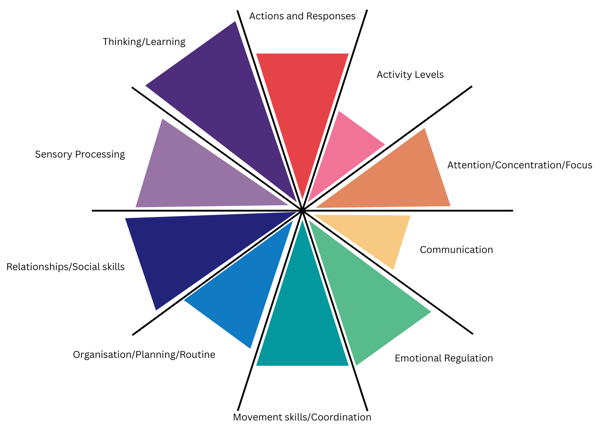
Everyone has strengths and challenges and this is the same for neurodivergent people. The neurodivergent wheel helps us to understand a neurodivergent individual’s experiences, strengths and challenges at any given time or place. Neurodivergent people thrive in the right environment with the right supports. The wheel can help to build empathy and understanding. It also helps to make sure that the right support is given at the right time.
This is an example of an individual's profile. It shows the spectrum of differences. Remember a person's profile can vary over time and in different environments.

Thinking and Learning
 People with FASD think and learn differently. This means that they might need extra support at nursery or school to help them reach their full potential.
People with FASD learn concrete concepts best, often preferring to learn using a visual or ‘hands on’ approach. Learning something using real life examples and resources can be helpful. Learning about and understanding abstract ideas and concepts can be more challenging. This can mean that learning about maths, time and money can be hard. Planning, sequencing, problem solving and organisation can also be difficult.
People with FASD can have difficulties with memory but tend to have better visual memory. These difficulties can make it hard to follow complex instructions and sequences.
Moving from one activity to another or unexpected changes can be difficult for people with FASD. This can mean that they have a need for predictability and sameness. Changes that seem small to other people can be difficult for people with FASD.

Actions and Responses
People with FASD can find it hard to adapt or change how they act or respond in a situation. Understanding consequences can be challenging. This means that mistakes are often repeated.
People with FASD can be persistent, determined and hardworking. This means that they keep trying even when something is difficult and needs a bit more work.
 Movement and Coordination Skills
Developing movement and coordination skills can be difficult for some people with FASD. For instance, they may have difficulty learning to walk, run, jump, hop, skip, throw and catch or ride a bike. It might also be difficult to do/undo buttons, zips or shoelaces, use scissors or learn to write. Some people with FASD might appear clumsy.
On the other hand, movement skills can be an area of strength for some people with FASD who can be athletic.
Sensory Processing
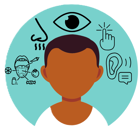 The way we get information from our senses and what our brains do with it is called sensory processing. People with FASD often process sensory information differently. Some people with FASD find joy through their heightened sensory experiences. This might lead them to develop particular skills in an area of interest.
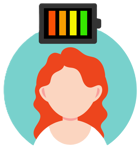
Sometimes, people with FASD need to use lots of mental and physical energy to notice or tolerate the sensations involved in doing everyday activities. Sensory experiences can be overwhelming for people with FASD including noise, touch or smell and they may try to avoid them.
Activity Levels and Attention
People with FASD often have lots of energy and enjoy being active. This can be infectious and encourage other to join in. This sometimes means they are always on the go and need lots of movement. They can sometimes be impulsive, acting without thinking about the consequences, shouting out and saying the first thing that comes into their head. Paying attention and focusing can be challenging for people with FASD as they are often easily distracted.
 Relationships and Social Skills
People with FASD can be caring, friendly, generous, helpful, keen to please and have a strong sense of justice. This means that they are often good with younger children, older people and animals.
Some people with FASD may not understand personal boundaries and have difficulty reading social cues. This can make them vulnerable and easily taken advantage of.
 Communication
People with FASD communicate in a range of ways. Some people might use words and sentences and communicate clearly. Others may need support to use alternative methods like signing and symbols. Understanding language and complex instructions can be difficult and people with FASD may benefit from adults adapting their communication and using visuals (like pictures and gestures) to support understanding.
What you can do to help
Thinking and Learning
Focus on the child or young person with FASD’s strengths. Think about their stage of development rather than what might be expected for their age and meet them where they're at.
Use activities that are meaningful to the child or young person and use real life examples and resources to support learning. Use a variety of tools to support learning, like visuals, hands-on tasks, and spoken instructions. Allow time to think and respond without pressure. Repeat instructions if needed. Patience is key.
When teaching new skills, break tasks down into steps. Teach one step at a time and use visuals or checklists to help with remembering sequences. Demonstrate and practise tasks often. This can help with remembering and with building confidence.
Set up and stick to a routine and prepare for changes with simple explanations and visuals.
Praise effort and growth to build confidence.
Actions and Responses
Try using a Buddy System. Pair the child or young person up with a peer or adult who can model tasks, give guidance, and offer encouragement.
Use clear, consistent rules to help with building understanding of personal safety and boundaries. Role play can be a helpful way to practice what to do in different situations.
Allow extra time for thinking and responding without pressure. Revisit instructions gently if you need. Meet the child or young person where they are. Adjust your expectations to their developmental stage rather than their age.
Movement Skills and Coordination
When teaching new skills use the child or young person’s interests to help keep them motivated. Demonstrate and practise tasks often. Practice in real life when you can. Try using a variety of tools to support learning, like visuals, demonstrations/ watching videos and spoken instructions.
Break tasks down into steps. Teach one step at a time and use visuals or checklists to help with remembering sequences. For more information about teaching new skills have a look at the Backward Chaining Technique information sheet.
Focus on effort and progress and praise this to build confidence.
Sensory Processing
Adapt the environment to meet your child/young person's sensory needs. Create quiet areas for relaxation when feeling overwhelmed. Reduce noise, light, and other sensory input in busy or overwhelming spaces. Consistent routines help with physical and sensory regulation, reducing stress and confusion.
Include regular physical activity or sensory breaks throughout the day to help manage energy and focus. Give advanced warning before activities involving sensory changes (like loud assemblies, PE lessons, messy play). Offer sensory tools to support regulation. You could try chew items or fidget tools.
For more information look at our I’m concerned about sensory processing page.
Activity Levels and Attention
Include regular physical activity or sensory breaks throughout the day to help manage energy and focus. Doing activities in different positions can be helpful. Try kneeling, standing or lying. Using “active sitting” equipment can help when people with FASD have to sit down. Lots of children and young people have told us that wobble cushions, wobble stools, exercise balls or putting a resistance band around the legs of the chair can all help. Using fidget tools can help to keep hands busy. You could try a pen top, a key ring, lump of blue tac, a bracelet/wrist band, elastic band or hair bobble. Anything that keeps hands busy but doesn’t become more interesting than the task that needs to be completed.
Create a calm, clutter free environment and reduce distractions where possible. Give simple instructions, one step at a time and repeat them if needed. Use check lists or timers to support focus. Predictable routines can be helpful too.
Relationships and Social Skills
Discussing social relationships with a person with FASD might be supportive. Using tools like social stories and comic strip conversations can be helpful. These were originally designed for use with autistic people however these can be used with any neurodivergent person.
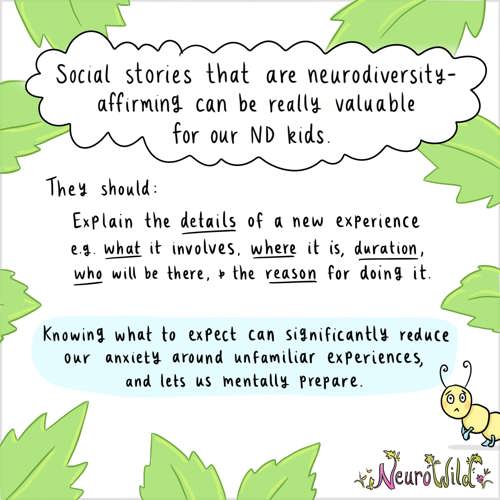
Neuro-affirming Social Stories
Social stories are simple stories that can help to prepare neurodivergent children and young people for new or difficult events. To be helpful the stories need to include:
- Information about what your child/young person can expect to happen.
- Personalise it
- Include answers to the questions your child/young person might ask
- Include photos of environments, people and activities.
- What options your child/young person has:
- Include any accommodations they can use or request
- Include who can help them if they have big feelings or are overwhelmed in the situation.

For more information look at:
- the Social Stories infographic on NeuroWild
- Carol Gray Social Stories
- What are Comic Strip Conversations? from Whittington Health NHS Trust
- Comic strip conversations and social stories from Bedfordshire and Luton's Children's Speech and Language Therapy Service
You could also try using a Buddy System. Pair the child or young person up with a peer or adult who can model tasks, give guidance, and offer encouragement.
Communication
Keep your language simple. Use short direct sentences. You might need to repeat what you say or rephrase it to help with understanding. Ask the person to repeat instructions back in their own words, to make sure they understand. Use visual supports and gesture to give extra clues. Give extra time so the person can process what is being said. Focus on what they are trying to say rather than how they say it.
Local and National Resources
- FASD Hub Scotland from Adoption UK
- National Organisation for FASD
- Fetal Alcohol Spectrum Disorder (FASD) from SIGN Health Improvement Scotland
- The Brain Domains Pack in FASD Hub Factsheets from Adoption UK
- Understanding Fetal Alcohol Spectrum Disorder (FASD): Information for parents and carers from the Fetal Alcohol Advisory Support and Training Team
- Alcohol and Pregnancy from NHS Inform